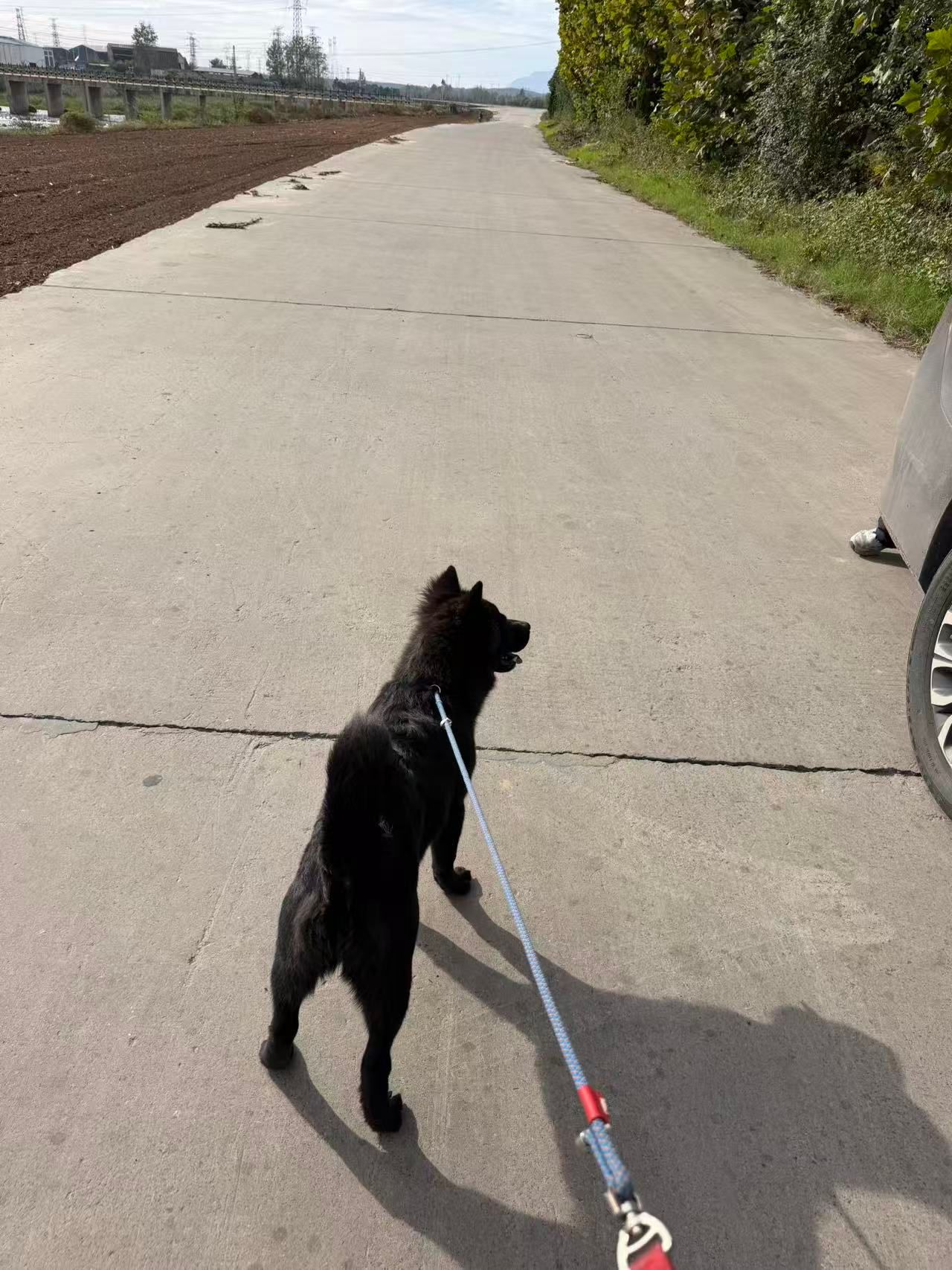
# Loose Leash Walking: How to Teach a Dog to Walk With You
A dog straining at the end of the leash is not being stubborn, and not making a point about who is in charge. He is doing the one thing the leash has reliably taught him: tension gets you closer to what you want.
Change what pays, and the walk changes. That is the whole method.
We make dog supplement chews — that is the business behind this blog, so take everything here with that in mind. Nothing we sell has anything to do with the training below.
Why dogs pull (it is not what you think)
Three things are usually happening at once.
- Pulling gets paid. Every step you take on a tight leash rewards the pulling. It only has to work sometimes.
- The opposition reflex. Pressure on the chest or neck makes a dog lean in and pull harder. Tugging back means you have joined in.
- Gear and genetics. Sled and tracking breeds were built to lean into pressure. A retractable leash pays out more length exactly when the dog pulls.
None of that is a discipline problem. It is a training gap, and it has a fix.
The five-step method
Practice in a boring place first — a hallway, the yard, an empty parking lot — and add distractions only once the boring place is easy.
- Charge the spot beside you. Stand still and drop a treat at the seam of your pant leg whenever she wanders into that position. No cue, no luring. You are making one square foot the best place on earth.
- Be a tree. The instant the leash goes tight, stop. Do not pull back, do not correct, do not say anything. Forward motion is the whole point of a walk, and it only resumes when the leash is slack.
- Pay the slack, then move. The moment she turns back to you or the line goes loose, mark it ("yes") and treat her beside your leg. Then walk on. Tension stops the walk; slack restarts it.
- Add the U-turn. If she locks onto something ahead before the leash tightens, cheerfully change direction. She learns to watch where you are going, because it keeps changing.
- Raise the difficulty slowly. Quiet street, then quiet park, then mild distractions, then the busy road. Keep sessions to five or ten focused minutes. Short and repeatable beats long and frustrating.
Two rules hold it together. Never move forward on a tight leash — not once, not even when you are late. And every human in the house does it the same way, or the dog learns that pulling works with the other person.
What ruins leash training
- Letting pulling work sometimes. One "fine, let's go" undoes a week of reps. Inconsistency is not a small leak; it is the whole problem.
- Yanking or popping the leash. That tells a dog the leash hurts. It does not tell her where you want her. She may keep pulling, and now she has a reason to dread the walk.
- Buying gear and calling it training. A front-clip harness changes how hard pulling is. It teaches nothing. Gear is training wheels, not the bike.
Does the gear matter?
It does, so get it right. The Clinical Animal Behavior Service at UC Davis lays the options out plainly:
| Tool | What it does | The catch |
|---|---|---|
| Front-clip harness | Redirects forward momentum sideways | Some dogs pull through it anyway |
| Back-clip harness | Comfortable and padded | Can make pulling easier by engaging the opposition reflex |
| Flat collar | Simple and familiar | The dog can still pull, and steady pressure sits on the throat |
| Head collar | Controls the head | Can be mistaken for a muzzle; needs slow introduction |
| Choke or prong collar | Tightens or pinches | Neck injury risk, precise fitting required, and it works by making the pull hurt |
One more line on that last row: the aversive end of the list is not just uncomfortable, it is unnecessary. A 2017 review in the Journal of Veterinary Behavior found no evidence that aversive methods train better than reward-based ones, and plenty that they put welfare at risk. A University of Pennsylvania study (Herron et al., 2009) found that owners using confrontational methods — prong and choke collars included — were more likely to report an aggressive response from their dog. The American Veterinary Society of Animal Behavior's training guidelines put it plainly: there is no evidence aversive training is necessary.
You do not need a tool that hurts. You need a treat pouch and some patience.
How long does it take?
There is no honest number of days. A front-clip harness takes strain off immediately; the habit builds over weeks of consistent reps. Expect a boring version of the walk for a while.
Which raises the fair complaint — my dog needs to sniff. Split the walk in two.
- Sniff walks, on a long line in a safe area, where she leads and you follow. That is enrichment, and it is not optional.
- Training stretches, five or ten focused minutes on a familiar route, where the loose leash is the entire point.
Do the training stretch after she has had some exercise, not instead of it. A tired dog learns. A wired one just rehearses pulling.
When pulling is not a training problem
Two situations belong with a professional, and neither is a failure on your part.
If your dog is showing fear, anxiety or aggression on the leash — lunging, barking, freezing, trying to bolt — UC Davis's guidance is direct: those dogs need a veterinary behaviorist assessment first, and that has to be addressed before leash training begins. A standard training plan is the wrong tool.
If a dog who used to walk fine suddenly stops walking fine, pause the training and call your vet. Lagging behind, refusing to walk, limping, or stiffness after rest is not stubbornness — that is a vet's call, not a label's. A dog who coughs or gags on a flat collar needs a harness and a veterinary opinion too.
Where our own products fit (and where they don't)
Nowhere near the leash. No chew teaches a loose leash, and nothing we make trains anything.
What we sell is nutrition: a daily chew built for slow, everyday feeding over weeks, plus another product that answers a completely different question. Neither is a training aid. When a walk has gone wrong, a supplement is not the shelf to reach for.
What actually decides whether the walk is pleasant is the boring list: daily exercise, one consistent method across every person in the house, gear that does not hurt, and a vet who knows your dog. A supplement is a small, optional layer on top of those — never a substitute for them. And if you do buy one, ours or anyone's, read the label before you buy anything, including ours, and ask what the numbers on it mean.