# How Fast Can a Dog Actually Run? A Soccer-Field Afternoon with Qiqi
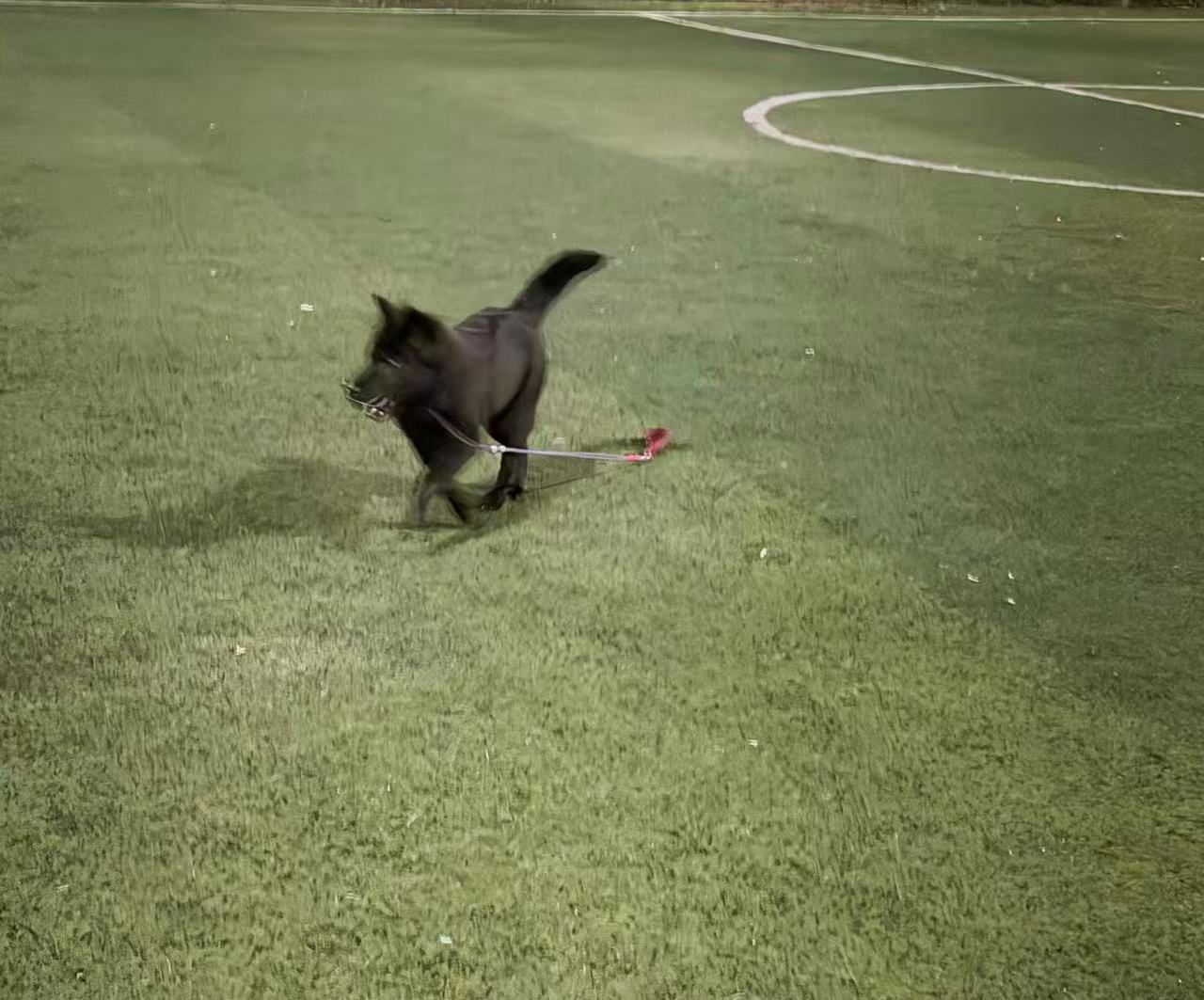
Last weekend we took Qiqi to the soccer field: me, my husband, both kids, one small dog and a lot of freshly cut grass. Someone kicked a ball, and she went.
Not a trot. A flat-out sprint — ears back, all four feet off the ground twice per stride, the kind of speed that makes you laugh out loud and then walk the fence line looking for gaps. She stopped when she was finished, came back with her tail going, and asked us to kick it again.
We make dog supplement chews. That is the business behind this blog, so take everything here with that in mind — and know that nothing we sell made that run happen.
So how fast was she actually going?
A healthy adult dog covers a short sprint at roughly 15–20 mph. That is already quicker than a jogger. The fastest human ever recorded managed about 27.8 mph, and the Greyhound — the fastest dog alive — tops 40–45 mph in a burst.
The honest answer for Qiqi is that nobody knows. No one brings a radar gun to a weekend kickabout, and her top speed is not the useful number anyway. The useful question is whether the ground, the temperature and the pace suited her — and all three are things you can check.
Speed is not a training achievement, either. It is architecture: long legs, a springy spine, and a gallop with two moments of full suspension in every stride. She is not fitter than you. She is built differently.
Why a grass field is a better choice than pavement
An open field gives a dog three things pavement never can: room to run in a straight line, grip when they turn, and a surface with some give. Sprinting over concrete means every stride is an impact. Grass absorbs most of it.
Two things worth checking before the lead comes off:
- Is it a dogs-allowed space? Plenty of school and club pitches are not, and a fine is an expensive way to end a nice afternoon.
- Real grass or artificial turf? Turf runs hotter in direct sun and is less forgiving underfoot. On turf, keep bursts short and go at the cool end of the day.
The five things we do before and after we let her go
- Five minutes of sniffing first. A slow lap on the lead with her nose down is the warm-up. You are not going to talk a dog through a hamstring stretch.
- Pick the cooler hours. Heat is the real risk, not speed. Water in the car, and a proper break in the shade halfway through.
- Let her set the pace. She stops when she stops. A dog who lies down mid-play is telling you something, and it is not stubbornness.
- Check recall before you unclip. The sprint is the fun part; the road on the other side of it is the part you plan for.
- Look at her feet afterwards. Pads, between the toes, a quick once-over. If she is limping the next morning and it does not settle with rest, that is a vet's call, not a label's.
Does running flat out hurt a growing dog?
This is the part where the internet hands you a number that does not hold up.
You will find the five-minute rule everywhere: five minutes of exercise per month of age, twice a day. PDSA, a UK veterinary charity, says plainly that there is no scientific evidence behind it and that it does not suit most puppies. The real concern was never the stopwatch.
The real concern is growth plates — the soft areas at the ends of a puppy's bones where growth happens. They are not finished until a dog is skeletally mature: often around a year in smaller dogs, and as late as 18 months to two years in larger breeds. Until then, the risk sits in high-impact and hard-turning activity: jumping down from height, skidding into turns, repeated full-speed fetch. Free play at their own pace is a different thing.
So the field is a grown-up's game. Puppies can absolutely have grass, kids and a ball — shorter bursts, fewer hard turns, and no flat-out sprints until the plates have closed. If you are not sure where your dog sits, that is a question for your vet, not for a website.
That's a summary of the guidance, not a product claim.
What are zoomies — and are they normal?
Those sudden explosive laps around the yard have a real name: Frenetic Random Activity Periods, or FRAPs. The American Kennel Club classes them as normal. They last seconds to a couple of minutes, they are most common in younger dogs, and the usual triggers are a bath, a meal, or the relief of being let out of a crate.
The one thing worth managing is the environment. Zoomies on a slippery floor or in a cluttered room are how dogs pull something. Point her at open grass and enjoy the show. If they become constant rather than occasional, read it as boredom or not enough mental work — not as something to fix with a pill.
Where our own products fit (and where they don't)
Nothing on that field had anything to do with a chew.
The only mobility product we make is a daily chew built for slow, everyday nutrition over weeks. It is not a warm-up and not what makes her fast. No supplement turns a dog into a sprinter, ours included. The other product we make answers a completely different question and belongs in a different article.
What decides afternoons like this one is the boring list: a healthy weight, daily exercise, a surface that does not punish them, and a vet who knows your dog. A supplement is a small, optional layer on top of those — never a substitute for them. If you do buy something for a dog who runs like this, read the label before you buy anything, including ours, and ask what the numbers on it mean.
What we'll change next time
Go earlier, before the heat builds. Take the long lead as well as the short one, so she can keep sniffing once the sprinting is done. And leave ten minutes at the end for all of us to come down before the car.
She slept for four hours afterwards. Best afternoon of her week — and honestly, ours too.