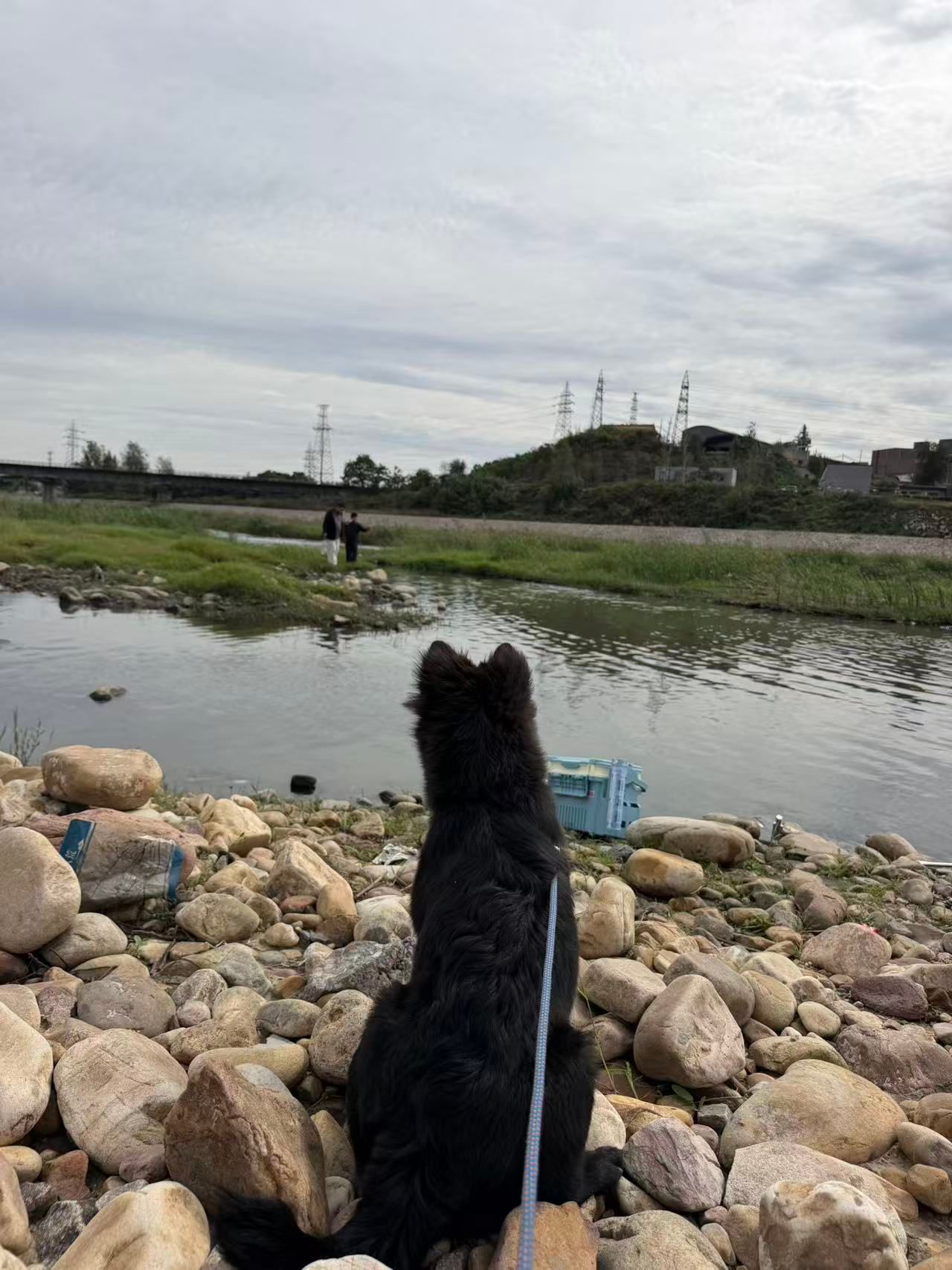
# Qiqi, Across the Water: What a Dog Sees From the Other Bank
We were on the far bank. Qiqi was on this one — [how it happened, and how deep the water was]. She did not come.
She stood at the edge and watched. The child waved. For [how long] nothing else happened.
I have thought about that half hour more than about most things she has done, because almost everything I assumed she could read from there was wrong.
What Can a Dog See From Across a River?
Not our faces. At that distance a dog is working with shape, movement and contrast, and their detail vision is much coarser than ours — far better at catching a hand lift than at reading an expression.
What she had was the shape of the group: two upright figures, one smaller, moving together, on the wrong side of the water. [What the child was doing] — that she would have seen, because children are the loudest thing in any landscape and the hardest to mistake.
Dogs also recognise familiar people by the way they move, not only by the way they look: the gait, the posture, the rhythm. So she knew it was us. She simply could not tell what we wanted.
That is the part I got wrong. I thought I was calling her. From her side of the river I was a shape that had stopped and turned around, which is not an instruction.
Why Won't a Dog Just Swim Across?
Entering water is a decision, and a dog makes it in a fixed order: how deep is it, what is under my feet, where do I get out, how cold is it.
We are usually only thinking about the first one.
Exit is the hard part. A dog can paddle out ten metres without difficulty and then meet a bank that is steep, slippery, or faced with stone. She is not weighing whether she loves you. She is weighing whether she can get back out.
Paddling is not swimming. A dog can do the first for a minute; body shape decides the rest. Flat-faced breeds tire fast because the airway is short, and a lean dog with no body fat loses heat in cold water far faster than a retriever does.
Current is invisible from the bank. A flow you can wade through will still carry a dog downstream, and the downstream side is usually the steep one.
How to Get a Dog Into the Water
The thing that works is almost never calling from the far side.
- Put one person in the water, on her side. A body in the shallows is an invitation. A voice across the water is pressure.
- Show her the exit before you show her the entry. Walk the edge to the ramp or the shallow shelf and let her see where the ground comes back up.
- Pick a slope, not a wall. Gentle entry, non-slip footing, no step down.
- Never throw her in, and never push. It may work once and costs you every attempt after it, and it is one of the ways dogs drown.
- Stop while she is still willing. Two minutes that end well beat ten that end with you carrying her out.
- A life vest is not an exit and not a teacher. It keeps a dog afloat on a boat. It does not solve a bank.
And if she never wants to swim, that is allowed. A dog who does not swim does not have a problem.
Water That Isn't Safe for a Dog
- Current you would not wade into. Same rule for her, with no exception for a strong swimmer.
- Cold. Small dogs and lean dogs lose heat fast, and shivering is late, not early.
- Foam, scum, or anything that looks like spilled paint or pea soup. That can be cyanobacteria. Onset ranges from minutes to a day depending on the toxin, there is no known antidote, and treatment is supportive care — which is why the clock matters more than the diagnosis. If she has been in it, rinse her with clean water immediately, stop her grooming herself, and call your vet. ASPCA Poison Control is on (888) 426-4435.
- Urban riverbanks. Glass, fishing hooks, wire. Check the entry with your eyes before her paws do.
When Not Swimming Is a Vet Question
A dog who used to swim and now will not is not being difficult. Ears, eyes, hips, back and pain all change how a dog feels about water, and she cannot tell you which one it is. That is a vet's call, not a training problem.
The Part I Keep
She was not being stubborn, and she was not testing me. She was standing on a bank, reading a shape, and missing the one piece of information I never gave her: where the ground comes back down to the water.
You cannot call a dog across water. You can only make the crossing obvious.
Where We Come In
We make dog supplements. That is the business behind this blog, so take everything here with that in mind.
None of it gets a dog across a river. There is no chew for a steep bank, and the answer costs nothing: a slope, a ramp, and a person standing in the shallows instead of shouting from the other side. The free things come first, and a chew is never a substitute for them.
If she is already on a joint or a fibre chew, keep her on it and change nothing else this month. Confidence in water is built in the shallows, at her pace, not in a tub. And read the label before you buy anything, including ours.
This is our experience with one dog, not veterinary advice.
Sources: CDC, Preventing pet and livestock illnesses caused by harmful algal blooms; Washington State Department of Health, Toxic blue-green algae bloom vet reference; AAHA, Blue-green algae and dogs; ASPCA Animal Poison Control Center.