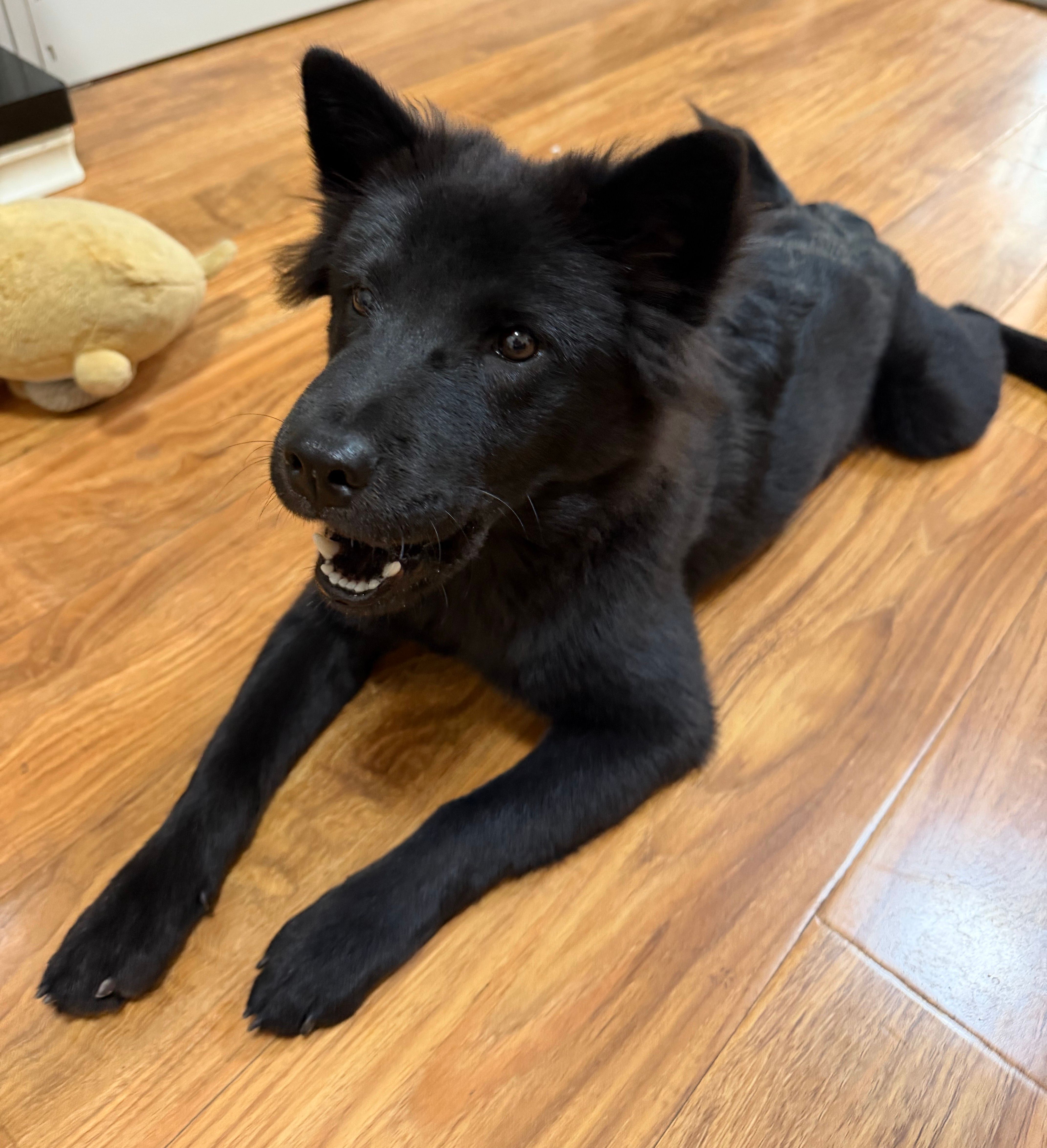
He Used to Pee in the Office — Now She Asks to Go Out
From the Qiqi's Growth Diary series
Qiqi comes to work with me most days. For the first stretch of that arrangement she peed wherever she happened to be standing: under my desk, by the printer, once in a meeting room. I spent a month apologising to people and keeping a roll of paper towels in my bag.
Then it shifted. She started holding it, and then — the part I did not expect — she started telling me when she needed to go out. A look, a walk to the door, a pointed stare across the room. Not a word, but I have never been more reliably summoned by anyone.
Here is what changed, and the things I got wrong first.
How Long Can a Dog Hold It?
Start here, because I had this backwards.
The rough numbers vets tend to give: a healthy adult dog can comfortably hold her bladder for around four to six hours, with eight hours as the outer edge rather than a target. A puppy manages roughly one hour per month of age, plus one — a guide, not a schedule to push.
Which matters, because holding it longer is not a skill worth training. A bladder emptied on time is the easier version of this for the dog's body, and it is the version vets would rather see. So the goal at the office was never "she can last all day." It was a timetable tight enough that she never had to.
What Actually Worked
- Fixed breaks. The same times every day: mid-morning, lunch, mid-afternoon, and last thing before we leave. Dogs learn a timetable fast — mine keeps better track of mine than I do.
- Straight outside, praise outside. Not indoors, not two minutes later. The praise has to land while she is still standing in the right place.
- No punishment, ever, and especially not after the fact. A dog cannot connect a telling-off at 3 p.m. to something that happened at 11 a.m. All that teaches is not to do it in front of you.
- Clean it properly. An enzymatic cleaner, not soap and water. If the smell stays, the spot stays interesting.
- Supervision for the first couple of weeks. If I could not see her, the habit had a chance to restart.
The reframe that helped more than any trick: accidents are a spacing problem, not a character problem. Nobody was being defiant. My schedule was wrong.
Making the Office Itself Easier
- Pick the spot outside and always use that one. Dogs generalise badly, and "outside" is easier to learn as one doorway and one patch of pavement.
- Water stays available all day. Restricting it to reduce accidents trades a small problem for a bigger one.
- Bring something that is hers — a bed or a mat — so the office has a place where she settles instead of a place where she wanders.
- Tell your colleagues. Half of the reason this worked was other people knowing not to offer her snacks at 11 a.m.
The Guilty Look Is Not Guilt
This is the part I got wrong. When I came back to a wet patch, she looked guilty: ears down, eyes sliding away, body low. I read that as a confession.
It is not one. In a study that staged exactly this, owners were asked to scold their dogs while the researchers controlled whether the dog had actually done anything wrong — and the "guilty look" tracked the scolding, not the misdeed. Dogs who had done nothing at all produced the same look when scolded for it (Horowitz, 2009). That's a summary of the research, not a product claim.
What I was watching was her reading my face, not her own conscience. Which means the look was my fault too: I was walking back already annoyed, and she knew before I said a word.
When Accidents Come Back
A dog who has been reliable for months and then starts having accidents is not being difficult. That is a vet question, not a training one. In an adult dog, a urinary tract infection, incontinence, and other conditions your vet will want to check are all more likely than a sudden change of heart — and in an older dog, cognitive change belongs on that list as well. Straining, blood, or lots of small trips in a short window are the same answer: book the appointment, do not re-run the training.
The Part Where We Sell Something
We make dog supplements. That is the business behind this blog, so take everything here with that in mind.
Nothing in the shop teaches a dog where to go — no supplement does, ours included — and this page would be dishonest if it pretended otherwise. If you remember one thing from this page, make it the timetable, the supervision and the cleaner. A supplement is a small, optional layer on top of that kind of routine — never a substitute for them — and a dog with a real problem needs a diagnosis, not a chew. If your dog has a health problem, that is a vet's call, not a label's.
The one thing I can offer from the shop side is a habit: read the label before you buy anything, including ours.