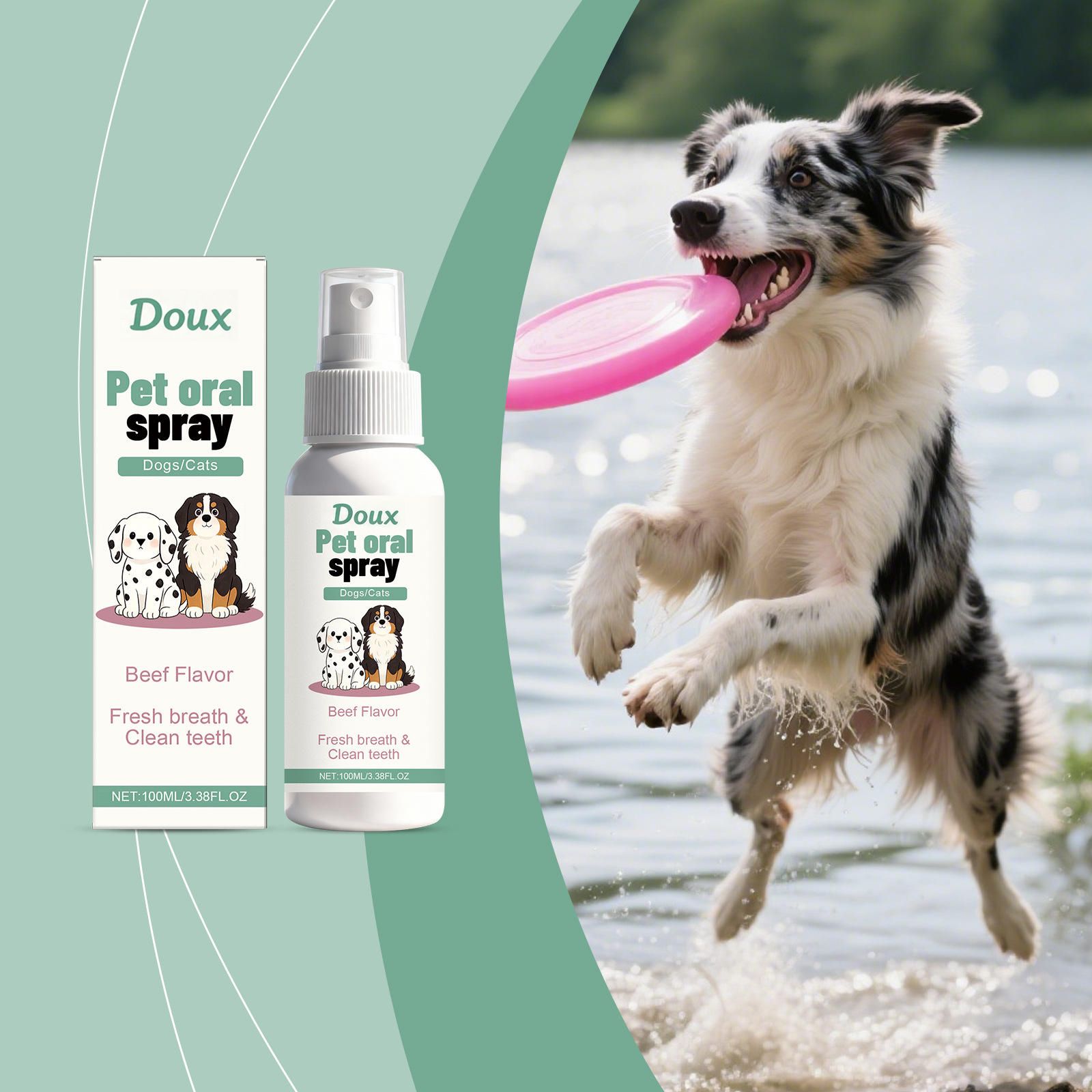
Dog Bad Breath Spray: How Enzymatic Oral Care Actually Works
Bad breath in dogs and cats is rarely a food problem. It's a bacteria problem. Once you understand that, the fix becomes obvious: stop the bacteria at the source instead of masking the smell.
This is how our pet oral spray is built — and, more importantly, why each ingredient is in it.
Why Your Pet's Breath Smells in the First Place
A pet's mouth is warm, wet and full of nutrients. That's an ideal environment for odor-causing bacteria to colonize the tongue, gums and the gaps between teeth.
As those bacteria break down food residue and proteins, they release volatile sulfur compounds — the same molecules responsible for the "rotten egg" smell. Brushing removes the bacteria mechanically. A spray works chemically. Most owners need both, and most reach for the spray far more often.
Two Mechanisms, One Bottle
Our formula combines an enzyme and a plant extract, because a single antibacterial route is easy for bacteria to work around. Two routes are not.
Lysozyme: the precision cut
Lysozyme is the primary antibacterial agent here, and its mechanism is well characterized.
- What it targets: the β-1,4 glycosidic bonds linking N-acetylglucosamine (NAG) and N-acetylmuramic acid (NAM) in the bacterial cell wall's peptidoglycan layer.
- What happens next: peptidoglycan is the structural mesh that holds a bacterial cell wall together. Cut those bonds and the wall weakens. Internal osmotic pressure then does the rest — the cell ruptures and dies.
- Where it works best: Gram-positive bacteria such as Staphylococcus aureus, which expose a thick, accessible peptidoglycan layer.
In plain terms: lysozyme is a pair of precision scissors. It snips the key joints in the bacterial cell wall and lets the cell fall apart on its own.
Honeysuckle Extract: many targets at once
Honeysuckle extract is not a single compound — it's a complex of active polyphenols, chiefly chlorogenic acid, neochlorogenic acid and isochlorogenic acid A. That complexity is the point.
It disrupts bacteria through several routes simultaneously:
- Interfering with normal growth and metabolism
- Damaging cell structure, causing contents to leak out
- Depleting the sulfhydryl compounds bacteria need to multiply
Because no single pathway is the whole story, resistance is far harder to develop. Think of it as a mixed unit attacking from several directions rather than one soldier at one door.
Vitamin C: supporting the environment
Vitamin C is a supporting player, not a primary antibacterial. Its job is to help maintain an oral environment that is less hospitable to odor-causing bacteria — and to work alongside the lysozyme and honeysuckle rather than compete with them.
What's Inside
| Ingredient | Role | What it does |
|---|---|---|
| Lysozyme | Enzyme | Breaks down the bacterial cell wall — the primary antibacterial |
| Honeysuckle extract | Botanical | Multi-pathway inhibition; disrupts bacterial metabolism |
| Vitamin C | Nutrient support | Helps create an environment unfavorable to bacterial growth |
| Purified water | Carrier | Delivers the actives; gentle and safe |
No alcohol. No artificial fragrance. Nothing in the bottle is there to cover up the smell — everything is there to remove its cause.
What It Helps With
| Benefit | How it's achieved |
|---|---|
| Antibacterial action | Lysozyme breaks down cell walls; honeysuckle disrupts metabolism |
| Odor control | Targets odor-producing bacteria at the source rather than masking them |
| Fresher breath | A cleaner oral environment once odor-causing bacteria are reduced |
| Dental support | Helps limit cavity-causing bacteria that contribute to tooth decay |
How to Use It
- Shake the bottle well before each use.
- Aim at your pet's mouth and press the pump 2–3 times.
- Use after meals, before trips, or whenever breath needs a reset.
- Formulated for pets only — do not use on humans.
Most pets accept the spray within a few days. Start with one pump and reward your pet right after, so the spray stops predicting something unpleasant.
Safety Notes
- This is an oral care product, not a medication. It does not replace veterinary treatment.
- Do not use on pets known to be sensitive to any listed ingredient.
- Keep out of reach of children and pets.
- Store away from heat and direct sunlight.
- If your pet has persistent bad breath, bleeding gums, drooling, difficulty eating or loose teeth, see a vet. Chronic halitosis is one of the earliest signs of periodontal disease, and no spray replaces a professional dental assessment.
FAQ
How often can I use a dog bad breath spray?
Two to three times daily is typical — after meals is the most useful timing. Follow the label on your specific product, and ask your vet if your pet is on other oral treatments.
Is a breath spray a substitute for brushing?
No. Brushing physically removes plaque; a spray reduces bacteria between brushings. The two are complementary, and sprays matter most for pets who won't tolerate a toothbrush.
Is lysozyme safe for dogs and cats?
Lysozyme is a naturally occurring enzyme found in saliva and tears, and it's widely used in pet oral care. That said, individual sensitivities vary — introduce any new product gradually.
Why does my pet's breath still smell after using a spray?
If odor returns within hours or comes with red gums, tartar or drooling, the cause is likely dental disease rather than ordinary bacterial buildup. That needs a vet, not a stronger spray.
Can I use a pet oral spray on my cat?
Yes, if the product is labeled for both dogs and cats. Cats are generally less tolerant of spraying, so aim from the side and keep sessions short.
Two mechanisms. Plant-based actives. Breath that makes your pet easier to be close to.